April 2008
NOTES FROM TRIP TO POLAND 18-21 APRIL 2008, commemorating Wildhorn/Most
1 on 15-16 April, 1944.
Harrod family – Mother, Jonathan & Jean, Stephen & Cathy, Rick &
Helen
Stayed at Grand Hotel Lublinianka in Lublin.
Throughout our stay we were treated like royalty; very
humbling.
Local people:
- Ewa & Jerzy Kubarski. Both
translated on different occasions. Jerzy travelled in our 9-seater Renault from Warsaw to Lublin.
Ewa arrived on Saturday. Both worked very hard translating continuously and accompanying us
everywhere.
Ul. Sybirakow 33
05-500 Julianow
Gmina Piaseczno (which is near Warsaw)
- Wojtek
Ryba arranged our itinerary and also translated continuously.
Mlodej Polski 32/26
20-863 Lublin
- Jacek & Justyna Rybi (Wojtek’s parents)
were great hosts – had wonderful tea with them, gave us each bottles of home-made honey liqueur, plus the best
locally produced mead. So generous. Jacek was ‘official’ photographer
throughout the visit and gave us each before we left a CD of photos plus CD of the TV broadcast.
- ‘Ant’ (Zdzisław
Bednarczyk) and wife (name?) arranged the local event with
- Prof. Stanisław Wołoszyn, emeritus prof. of Vet. Science, univ. Lublin and
regional commandant of AK in Zarzad region.
Prof. dr hab. Stanisław
Wołoszyn
Ul. Sozinskiego 8/23
20-040 Lublin
tel. 081 533 8194
- President of
Lublin City Council: Piotr Dreher
- Deputy Mayor of Lublin: Paweł Fijałkowski
Plac Wladysława Lokiełka 1
20-950 Lublin
Zastepcy.prezydenta@lublin.eu
The AK – Had 30,000 members during the war locally in Lublin district, one 12th of the size of
Poland. Nationally there are now approx 30,000 veterans still alive in Poland, 1300 in Lublin district,
av. age 82. Only 11 in Matczyn.
ITINERARY
Friday 18th
– dinner with Wojtek as his guests, Jacek and Jerzy also. Super restaurant with delicious food.
How generous and kind.
Saturday 19th – visit to Majdanek Concentration and Extermination Camp in Lublin.
(See below for impressions). Afternoon to Museum of Socialism – the period from 1945 to 1990
when Poland was a part of USSR. Unlike other countries, the Soviets didn’t try to take land into
communal ownership, nor did it dismantle or destroy the Church. The museum had many more-than-lifesize
busts of Stalin, Lenin, Polish communist leaders, peasants, and mothers rewarded with a medal for producing lots of children
for socialism. The museum was in the grounds of a beautiful stately home with amazing formal gardens.
Partly restored. When Communism ended in 1990 Jerzy said it was like a miracle to have freedom for
the first time since 1939.
At dinner we were surprised to be hosted by the City of Lublin, with a welcome by the Deputy
Mayor and President of the City Council. Present during the meal was the AK Professor. Again,
a lovely meal, feeling deeply honoured to be there. Presentation of flowers to mother, and gifts (mead, Lublin
book in pictures, a cup and plate).
Sunday 20th The Memorial of Wildhorn 1/Most 1. 11 am Mass in Matczyn
village church attended by 19 subdivisions of the Lublin district AK – all 80+ year olds, carrying their standards proudly,
in uniform wearing medals and each local commandant wearing a newly struck white cross with red and white ribbon.
The Polish government is soon to present a ‘gold cross’ medal to all AK veterans.
The church was filled to capacity, with us in reserved seats at the front as guests of honour. Very
humbling. Military band with trumpets accompanied a lady singing most beautifully in place of a choir.
The mass was dedicated to the memory of the Dakota crew and the five villagers killed in reprisal the following day.
Outside were more villagers listening to the broadcast of the mass, and the guard of honour, 30 young soldiers
with AK47s with fixed bayonets, who, with the band, led the procession half a mile or so down the road to the landing strip
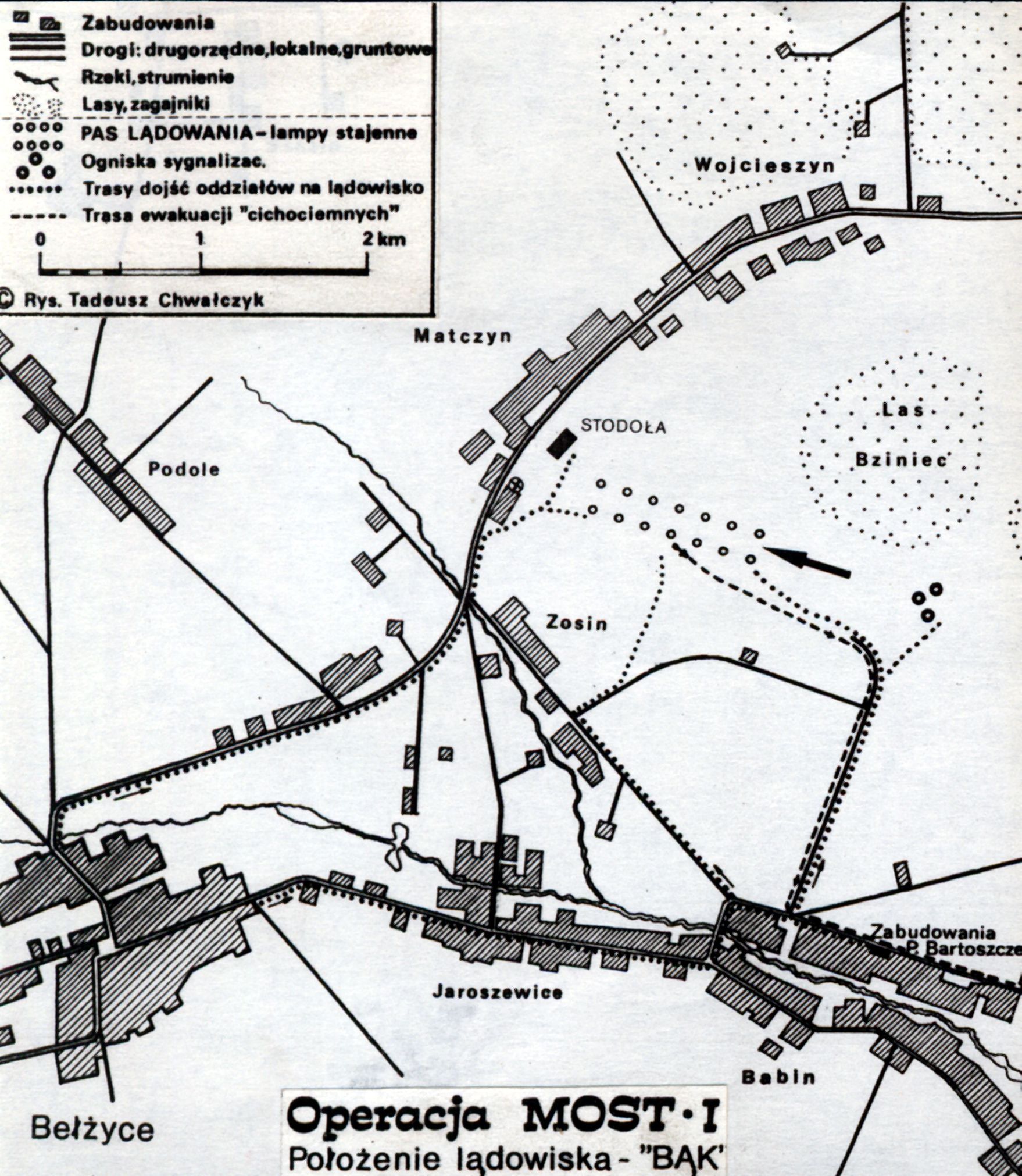
and site of the ‘obelisk’ or monument. There we were met by two guards flanking the monument
and a crowd of 200 or so villagers and AK members, local dignitaries and the local TV who interviewed Jonathan and Helen.
We were ushered into the enclosures either side of the monument, along with the professor who presided over the proceedings.
He spoke about Most and the events that night. Both anthems, British and Polish, were played, followed by a 30-gun
triple salvo salute – quite deafening and so moving; and then wreaths were laid – about 10 including one from
us – all in red and white, including ours, thankfully although we felt it was too small and must bring a larger one
in June. Jonathan spoke straight from the heart expressing our happiness at being with them and the privilege
it was to be there; about Dad’s ashes on the landing field; about the June flight of the Dakota. We
were then led up to the village hall, actually the part-time fire service hall, where the army provided pea soup – a
delicious concoction full of spicy sausage, potato and of course peas. As we were all perished it was most
welcome! The whole day was very emotional and moving to realise how much it meant to the people to
have us there with them. Dad’s trip was the first and I think only tangible proof of Allied support
to them locally during the entire war, to a country cruelly on its own against the tyranny of Hitler.
After a rest at the hotel, we hosted dinner for Ant and his wife, and Wojtek and his parents and talked about
the forthcoming June flypast.
Some more information about Wildhorn and
the AK
Polish Motto: God, Honour and Fatherland
On 15-4-44 after Dad took
off they prayed for a safe landing in Brindisi and were so relieved to hear on the radio of his safe return.
Ant has no knowledge of a previous RAF visit to the monument, although we had been told of it last year.
Ant and the partisans that night knew nothing of the operation, save what they did and saw (which wasn’t
much in the dead of night). It was only since the release of Polish war information after 1990 and then
after our visit last year that they learned what it was all about. AK and PLAF have had no contact about
Wildhorn, in spite of Fl Lt Korpowski, the co-pilot, being a Polish flying officer.
The Polish
military salute is 2 fingers, not the full hand as in England.
The people of Matczyn were
very pleased that the chosen landing strip was in their village, chosen as it was the only field long enough in the district.
On our first visit last year we had wondered if there would be resentment or even hatred
towards us from the villagers because of Dad’s operation causing the 5 deaths next day. They explained
that Poles believe all who die in the cause of the war die for a higher ideal so held no bitter feelings towards us.
It was obvious that in fact Dad was regarded as a hero, and Jon and Steve, because of their height, also as heroes!
(Just wait till they meet Matt, Ed and Chris one day!)
Before the war, no peasants
owned land. The operation was planned in the home of the landowner (the large house opposite the church,
now a home for disabled children) who owned the field. His wife was Ant’s godmother.
This family left the village when the Soviets arrived. The monument is on land now belonging to
the grandson of one of the men killed after the operation, who lives nearby. He offered his land in 1990,
as the current owner of the landing field did not want a monument on his land.
The only
AK partisans still alive who were there on the landing field are Ant and Stanisław Zydek, plus one other AK member who
was unidentified to us but can be seen in the pictures in the fire service hall at lunch. Three local partisans
died in the last 5 months leaving only 11 members in Podola district of Lublin (which includes Matczyn). No
one knows who was the local chief of the AK in 1944 because of the secrecy surrounding the organisation and its small
cell structure.
We were all, including the Poles, amazed at the series
of coincidences surrounding the coming together of our visit. After Jonathan last year on his initial business
trip had told Ewa about Wildhorn she spoke to her cousin, Jacek, in Lublin. He contacted the priest of
Matczyn who asked at Mass on 4 separate occasions for anyone who had been there in 1944. Eventually Ant’s
son was chatting to the priest and told him his father had been there. And the rest is now history…
STORIES ABOUT THE LOCAL AK DURING THE WAR
After
the end of WWII and Soviet ‘liberation’ many came into the open from the years of secrecy, but were put into prison
camps; 21,000 from Lublin sent to Siberia, a few survived. 15,000 Polish Army officers were killed.
The movement quickly went underground again. Accordingly, none of them were awarded Virtuti Militari.
In 1948 they were still being sent to Siberia. It wasn’t until 1958 and a change of government,
5 years after Stalin’s death, that survivors were released.
Ant has
a medal for bravery and injury incurred saving the life of a comrade who was injured while blowing up a train full of Nazis.
In August 1944 all were ready to go to Warsaw to help in the Warsaw uprising, but a despatch rider came in
time to stop them as the NKWD (Russians) would either kill them or send them to Siberia.
After
the War Ant’s brother escaped from the Russian invasion in Ukraine. He was given no help, no food,
no water, no shelter, not even information that the Russians were advancing towards him. This was indicative
of the way the whole of AK was treated by the Ukrainians.
In May 1944 an informant told the Nazis about an AK partisan pilot in the village of Matczyn.
They searched for him. He hid in a cellar with his cat. The Nazis opened the
cellar and the cat attacked their dog, which saved his life as they closed the cellar again. Not finding
him, 33 locals were executed in retribution. On another occasion a woman was arrested, tortured, her home
torched, she was put in prison in the castle in Lublin – but she would not betray the AK. They are
an amazingly patriotic and honourable people.
IMPRESSIONS OF MAJDANEK
FACTS: Built October 1941, ‘liberated’ July 1944 by Russians. 78,000 killed during
that time. 270 ha – the second largest in Europe, with 4 sub camps, but thankfully it was never fully
constructed. (Auschwitz killed 1.1 million, Buchenwald 800,000). On 3rd November
1943 18,400 Jews were shot on one day alone.
- 23,000 shoes in metal
cages in one of the store barracks
- Clothing was taken from prisoners and sold
- An
autopsy done on each corpse after being shot or gassed before incineration to remove valuables – gold teeth, etc.
- In
the washroom of the gas chamber hair was cut off – only the men’s for some reason – and sold for making
into fabric and other things
- Meticulous record keeping of the Germans. Lists of prisoners,
dates of birth and death, death certificates, belongings taken from prisoners.
- Urns
containing ashes were sold to relatives.
- A gallows in each compound or field as a daily warning
- Twin
rows of high voltage electrified barbed wire and observation towers surrounded each field
- Slept on three-tier
bunks with only a straw-filled palliasse and thin blanket.
- Food: breakfast was ½ ltr herb tea; lunch
a bowl of thin soup; supper was potatoes
- The gas chamber was marked outside as ‘Bath & Disinfection’
– given to calm the prisoners down before being packed into the gas chamber so tight that the bodies were
still standing upright after dying.
- Gas was initially CO which took 40 minutes to kill; later Zyklon
B took only 10 minutes.
- Crematorium – The furnaces could destroy 1000 corpses a day.
52 nations were imprisoned there (including all the national groups of greater Russia).
- Wagons
were also used as funeral pyres – we saw their twisted chassis’s.
- Execution trenches were dug especially
for the slaughter of 18400 Jews on one day, shot, naked, 5 at a time – in order to reach a target number of Jews
killed by that date.
- Mausoleum erected (I think after 1990) housing a gigantic pile of the ashes of those
murdered in the camp. The inscription reads: Let our fate be your warning’.
July 2008
“OPERATION WILDHORN 2008”
“AKCJA
MOST 2008”
BRIDGES TO THE FUTURE
Operation Wildhorn 1
Commemorative Flight and Celebrations
Schedule of events for 4-7 June 2008
| Activity | Wednesday 4 June |
| Combes depart Luton to Warsaw |
08h15 |
| Combes arrive Warsaw to stay with Kubarski
| 11h40 |
| Harrods leave Gatwick Airport and fly to Warsaw
| 11h55 |
| Harrods arrive Warsaw and collect Hire Car
| 15h25 |
| Harrods drive to Lublin and Grand Hotel Lublinianka (GHL)
Combes/Patricia Harrod overnight
in Warsaw |
16h00
– 19h30 |
| Dinner
with Wojtek and discuss details for Matczyn and catering for reception with GHL staff | 20h30 - 2300 |
| | Thursday 5 June |
| Recce field and topography for final plan of fly past
| 10h00-12h30 |
| Combes & Patricia Harrod arrive GHL
| 12h00 |
| Afternoon for last minute emergencies
| 12h30 – 16h30
|
| Meet Al Pinner at Radawiec and transport to Hotel Campanile
(NB. Security to be provided
for Spitfire overnight) | 12h30
– 13h30 |
| RAF
arrive Hotel Campanile | 14h30
– 15h00 |
| RAF
meet Harrod Party and Lublin Friends for tea | 15h45 – 16h30 |
| Depart for Matczyn in PLAF transport for RAF and own transport for locals / Harrod party
| 16h30-17h00 |
| Drive past Monument and stop at Church to meet priest
and AK Veterans and other Matczyn dignitaries. Lighting of candles for 5 executed villagers killed
in reprisals by Germans on 16 April 1944 | 17h00-17h30 |
| Arrival at site, parking and deployment to field with flags | 17h30-18h00 |
| Fly past x 3 by BBMF Dakota | 18h00-18h10 |
| Relocate to monument | 18h10-18h20 |
| Wreath laying, presentation of 267 Squadron plaques, speeches, etc. | 18h20-19h00 |
| General discussions, history lessons, etc. and meeting more of the
locals (AK, schools, etc.) | 19h00-19h30
|
| Take farewell of locals and depart to Lublin
| 19h30 |
| Drinks and buffet dinner for evening party (see below)
at GHL |
20h00-22h30
|
| Post dinner drinks and cash bar |
22h30 – late
|
|
| Friday
6 June |
| Static
display with Spitfire at Radawiec | 13h00 – 15h00 |
| Harrods/Combes depart to Warsaw | 15h00 |
| Spitfire Vistula flypast | 18h30 TBC |
| Farewell drink with RAF | 20h30 – 22h30 TBC |
| | Saturday 7 June |
| Harrod party departs Warsaw to UK/Nice | Various times |
Anticipated attendees at the field and monument:
| Harrod
and Combe families: Patricia Harrod Stephen and Catherine Harrod Alexandra
Harrod Jonathan and Jean Harrod Jessica Harrod Matthew Harrod + Dawn Latham-Mahoney
Edward
Harrod Helen and Richard Combe Patricia Dowling Stephen Combe |
14 |
| Rybi family: Jacek & Justyna
Rybi Wojtek & Krzysztof Rybi Jerzy & Ewa Kubarski | 6 |
| RAF representatives: Squadron Leader Al Pinner Squadron Leader Howard
Leader + 5 others | 7
|
|
AK Representatives:
Prof.
Stanisław Wołoszyn Zdzisław Bednarczyk Mrs Teodora Bednarczyk Czesław Bednarczyk
Stanisław
Zydek Tadeusz Chwalczyk | 6
|
|
Lublin City representatives:
Dr
Adam Wasilewski - Mayor Paweł Fijałkowski – Deputy Mayor Piotr Dreher –
Chairman of City Council Voivod of Lublin Region | 4 |
| PLAF representatives: Colonel Tomasz Krzyzak General Tadeusz Gora
| 2 |
| British Embassy representatives: Lt Col Andrew Nowak
– Defence Attaché Mrs Sarah Nowak Michael Parsons - Support to the Attaché
Witek
Opertowski - Driver | 4
|
|
Others:
Abigail
Uden – BBC Oxford Emma Ruminski – BBC Oxford Adam Gruszecki - Radawiec
| 3 |
| TOTAL | 46 |
Anticipated attendees at evening celebrations
| Harrod
and Combe families: Patricia Harrod Stephen and Catherine Harrod Alexandra
Harrod Jonathan and Jean Harrod Jessica Harrod Matthew Harrod Dawn Latham-Mahoney
Edward
Harrod Helen and Richard Combe Patricia Dowling & Stephen Combe |
14 |
| Rybi family: Jacek & Justyna
Rybi Wojtek & Krzysztof Rybi Jerzy & Ewa Kubarski | 6 |
| RAF representatives: Sqn Ldr Al Pinner Sqn Ldr Howard Leader
Sqn
Ldr Marcus Lee Flt Lt Miles Davey Flt Lt Owen Harcombe C/T Keith Brenchley Cpl Dennis Clegg Cpl Andrew Bale J/T Leigh Poiner
SAC
Mark Barlow SAC Scott Baldwin SAC Adam Hulston SAC Mark Dixon | 13
|
|
AK Representatives:
Prof.
Stanisław Wołoszyn Zdzisław Bednarczyk Mrs Teodora Bednarczyk Czesław Bednarczyk
Tadeusz
Chwalczyk |
5 |
| Lublin City representatives:
Dr
Adam Wasilewski - Mayor Paweł Fijałkowski – Deputy Mayor Piotr Dreher –
Chairman of City Council Voivod Lublin - TBC | 5 |
| PLAF
representatives: Colonel Tamasz Krzyzak General ?? – B of B |
2 |
| British Embassy representatives: Lt Co Andrew Nowak –
Defence Attaché Mrs Sarah Nowak Michael Parsons - Support to the Attaché
Witek
Opertowski - Driver | 4
|
|
Others
Abigail
Uden – BBC Oxford Emma Ruminski – BBC Oxford Adam Gruszecki - Radawiec
| 3 |
| TOTAL | 52 |
4 tables x 7 plus 3 tables x 8 = 52
Unanswered questions and actions required
| What
to be done? | By whom? | By when? |
| Approval of theme, itinerary and flyer/invitation from RAF BBMF | S/L Pinner / Stephen Harrod | Done
|
| Approval of invitation
from AK and Lublin Mayor | Wojtek Ryba
| Done |
| Permission from field owner to access field | WR |
Done |
| Confirm access to field from Fire Service Hall car park
and permission to use car park | WR
| Done |
| Availability of Dęblin airfield: NOT – Dakota will land at Minsk | RAF | Done |
| Confirm booking at Campanile Hotel for 14 RAF personnel | RAF |
Done |
| Print invitations and flyers |
SH/WR | |
| Details of other AK’s, Matczyn priest and schools to be invited to field event |
WR | |
| Invitations to Prof. Stanisław Wołoszyn, Zdzisław Bednarczyk and son, Mrs Bednarczyk, Stanisław
Zydek, other AK’s, plus arrange transport | SH
& WR |
|
|
Invitation to Lublin Mayor
and City Council CEO (Wasilewski, Dreher and Fijałkowski) | Prof Wołoszyn via WR |
|
|
Invitation to Embassy for Ambassador
and Military attaché | RAF
| Done |
| Lublin TV to be advised | Prof W and WR |
|
|
267 Squadron plaques for AK/Mayor
| SH | 23 May |
| Flags and flagpoles for airfield (Helen has Union flag (90cm x 143cm) | SH/HC/WR | 23 May
|
|
RAF Roundel wreath
| SH/Helen Combe | Done |
| Reception/dinner plans at GHL | Jean
Harrod |
30 May
|
|
Confirm security for Spitfire
at Radawiec 13h00 5.6.8 – 15h00 6.6.8 | WR
| ASAP |
Map Reference Co-Ordinates for the fly past:
51°12’5” N
22°19’30” E
April 2010
Hero
boys road trip due to Iceland volcano eruption and grounding of all flights
JEH Notes
from Matczyn and Wildhorn/Most Commemoration service Sunday 18 April 2010
To
all of you who couldn’t make it to Poland this year, here are some immediate thoughts as I sit here waiting for 19h00
when Wojtek and his fiancée Kasia join us at the Lublinianka Hotel lounge for drinks before we head out to a small
dinner. Steve has written his notes and, not being a coffee virgin, has nodded off to get some well-earned rest for
our trip tomorrow. I am levitating around after drinking the glorious coffee mud (the spoon stood up in it with an inch of
silt in the bottom of the cup!). This feeling must either last another 30 hours more or go in the next 4 or tomorrow’s
trip will be a challenge too far!
Ø We are all ‘Hero Boys’. Not just Steve
and me but all of Ted Harrods descendants and greater family. You will see why as I progress.....
Ø We are dearly loved by this small community of AK veterans / survivors and their families and all
the Matczyn / Lublin residents and officials who have got to know about us or meet us since our now 5 visits since July 2007!
Ø Today’s commemorations were overshadowed by two events (1) the volcano eruption in Iceland that
has frozen air travel in Europe for 10 days and (2) the tragic air crash of last Saturday when the Polish President and 100
of his trusted lieutenants and his friends ploughed into the ground after hitting trees at a failed landing in Russia.
Ø The outcome of the volcano fallout was the 22 hour and 1,900 km car dash Steve and I made to be here
in time for the service this morning at 11h00. What we felt was elation at doing a mad and romantic thing to honour
Dad/Ted, completely spontaneously and completely without regard to health and safety. It was a question of the heart
leading the mind
Ø What we did not realise was the impact this gesture made on all the community here, who had resigned
themselves to the fact there would be none of Pilota Harroda’s immediate family here. What they could not
believe was the commitment we’d shown to make happen the pledge we’d made last year to be there. As Steve
said in public, not even volcano eruptions would keep us away!
Ø On this point, for those
of you who don’t know, Prince Charles wimped out of coming to the President’s state funeral today in Krakow because
he could not get there by ‘plane! I’m sorry. He of unlimited funds; a helicopter pilot, and owner
of numerous fast cars; who could hire any vehicle at any cost says he could not make it!! Well we did in a 13 year old
1400 cc car, and our bonds at the grassroots level flourishes as a direct result while at a national level Poland has been
let down. Let me not digress!
Ø Now we sit waiting to leave
again at 03h30 tomorrow morning for another 22 hour dash home (where is my Jag on the German Autobahns?). We will be
reminding ourselves of the ‘Priceless’ tag of this gesture and venture - remember the MasterCard ads?) .....Cost
of petrol for trip...€400; cost of wear and tear on vehicle .....€250; Cost of wreath €50.....value of seeing
our friends’ faces and hearing their heartfelt applause for us being there ....Priceless! We wish you could all
have been here just for that, and thank you to Mum / GM and R&H for your financial contributions towards the costs of
this trip.
Ø I was touched by the number of people who asked after GM (Pilota Harroda’s wife). She
beyond all of us has made the largest impact to this community. The fact that she was the wife of this man that is as
someone else said to us “A hero of Poland and England”..... It was in the context of....... ‘My father
(who was there in the beetroot field with Ant that night in 1944) is MY hero, but your father is a hero of Poland....and England!
Ø The fact we have all built the bridge again (since July 2007) between these people and us means so
much to them. They assume (and some insist) that this is an annual event. Long may it be possible!
Ø The priest (who is doing his doctorate in Quantum Mechanics!) spoke to us at length and asked especially
to be remembered to our family
Ø Ant invited us to the AK lunch after at a nearby Tavern
4km away in another town (the coffee mud). Here after a hearty farmers’ soup and a massive helping of fried chicken
and vegetables, we were again thanked for our efforts and again the point was made of the bond between them all and our family.
The Professor who is
one of the AK ‘leaders’ and now 90 was there in fighting spirit as was Ant and Stanisław, his friend who
walked back from Germany in 1944 after escaping prison camp. We were hugged and kissed 3 times by everyone and I have
beard rash again though it is for the first time in 12 months!
Ø Tadeusz is writing his book (still) and wishes us all well
Ø The lady who owns the field
where the monument sits came out and smiled graciously at all the proceedings
Ø We were told the BBMF Dakota
flying around in June 2008 had been seen and commented on by ‘everyone’ in the area and it had bonded them together
in some way
Ø The soloist with the angel’s voice is still there leading the singing at the church service.
The singing was as always sublime
Ø 90 minutes of listening to Polish during the Service with
‘Pilota Harroda’ being mentioned twice were the only words I recognised except for ‘Presidente’, allowed
me time to reflect. I saw our family stretching back to as far as I know and going forward to Peanut (Jess’s unborn
baby), Jess and Rob, and Ted somewhere in that all: Ted’s role in succeeding in the Wildhorn mission, us making
the connection again so many years later in 2007 and what might come next. Would Peanut ever sit in this church?
Why would he have an interest to be here? Who would have told him? Why would it be relevant to him and why would he
ultimately decide to invest his time effort and money to make it happen again and play his role however it might be in the
2025 version of Most or Bridge.
Ø I felt Dad / Ted there in that church today for the first
time. I knew the only reason I was there today was to represent him. In truth he should have been there.
He wanted to be there. He was there. After all he would have been 93. All the veterans are between 83 and
95 plus. He was one of the older ones at 28 in 1944. Some were only 17! If he was alive they would have
wanted to meet him and become his friend. Second prize was meeting his wife and third prize would have been meeting
his Brother, Bob. Fourth prize was meeting his ‘strong’ sons again. I was honoured and humbled to
be there today with Steve and fulfil that representation as well as we could.
Ø Most and Wildhorn is not
about Ted, or me, or us. It is about all of us respecting and honouring those who gave their lives and effort to make
this world a better place for us and future generations. The world has many events to commemorate this. The Cenotaph
in London at the 11th hour on the 11th day of the 11th month comes to mind and happens every
year. The Queen representing the people of Great Britain leads us all in honouring them. We are all lucky to have
this moment, but we, the greater Harrod family, are luckier than most because we have our own ‘cenotaph’ in Matczyn
(smaller and less well known!) with our own flesh and blood being honoured in particular for their sacrifice and courage.
Ø I decided then that 15 April and being in Matczyn becomes a non-negotiable for me not honouring it
in some way. Our own 11th of the 11th..... Our own moment to pause and play our part
in cementing respect, honour, trust, friendship and loyalty into our lives. We have started something which we should
not stop; cannot stop; must not stop....... Though I will stop here or almost here!!
Those of you who have read this far, please copy me an acknowledgement
of making it this far! I fully understand those of you who don’t have time for e-mails of this length or content.
But even if you have scanned this far without reading the fine print, just reply to me and acknowledge that 15 April and the
first Sunday thereafter, will be remembered by you and yours in some way from now on in. In my eyes, it would make your
Grandfather /Ted’s premature death at 51 worthwhile if I felt his shortened life had enabled a worthy and lasting link
between us all that was ours to keep and cherish as I know only we can.
Phrases to be used:
We are very
sad for the tragic death of your president and his wife but we are happy to return to Poland.
Jest nam bardzo pshikro
z powodu tragieznej smierci vashago prezydenta y yego dzone, ale jesteśmy szczęśliwi z wrociliczme do Polski.
It is good
to see you again.
Dobrze zobaczyć cieu snovush.
You are looking
well.
Dobrze vi glondascz.
Thank you for being with us today.
Dziękuje
ze byliscie dziś z name.
See you again next year.
Do zobaczenia nastempno rok.
Thank you
Dziekuje.
April 2011
No
notes made!
Speech:
We are very pleased to be back in Poland and this
time we bring the youngest grandson of Pilota Harroda to meet you all.
Bardzo sie cieszymy ze moglismy powrocic do Polski. Tym
razem
przyjechal z nami najmlodszy z wnukow Pilota Harroda zeby poznac was wszystkich.
The other
members of the family are sad not to be here but send their best wishes and greetings to all.
Niestety reszta rodziny niemogla byc tu dzis z nami ,
ale przesylaja wam najlepsze zyczenia.
It is very special to us that
you all continue to remember our father’s visit here in 1944. We hope to continue coming back every
year to see you and remember him also.
Jest to dla nas bardzo wazne, ze wszyscy pamietacie wizyte mojego ojca w roku 1944. Mamy nadzieje, ze bedziemy
widywac sie przez nastapne lata i pamiec o mojim ojcu niezaginie.
We must specially
thank the Ryba and Kubarski families for all they have done to bring us together over the past five years. Thanks
also to Professor Wołoszyn and Zdzisław Bednarczyk for all their work in making this possible.
Chcielibysmy szczegolnie podziekowac za wszystko
co zrobili w ciagu ostatnich pieciu lat rodziny Ryba I Kubarskich. Rownierz chcielismy podziekowac Prof. Woloszyn i Zdzislawowi
Bednarczyk za cala ich pomoc w zorganizowaniu calej uroczystosci.
We look forward to seeing you again next year and
thank you all for coming today.
Dziekujemy wszystkim za przybycie tutaj w dzisiejszym dniu i do zobaczenia w przyszlym roku.
April 2012
Highlights of 5th Operation Wildhorn Trip to Matczyn 20 April
2012
1.
As always, the car ride from Warsaw’s Chopin Airport to Lublin, the
5 of us (Jonathan, Steve, Cathy, Mum, Edward) + Dakota Model in 9 berth people carrier!
2. The Grand Hotel Lublinianka graciously accepts us yet again with endless charm
3. On our trip to the monument Friday morning, the trees on the LHS adjacent to the beetroot field continue
to awe us, and then we see the crowd on the RHS of the road gathered at the monument, flags flying and uniforms proudly worn
by the AK veterans
4.
A trumpeter adds an evocative ‘sound backdrop’ to the wreath
laying as Ed and I position what must be the largest wreath ever made. We touch the (new) granite commemorative plaque
5. The leader of the Lublin AK humbles us by presenting Patricia with the AK medal, as well as her membership
to the AK
6.
We move to mass at church where we notice only 12 AK veterans, 5 less than
last year. Is it just that this is a Friday and not Sunday, or have some of these warriors fought their last fight?
7. The Junior School hosts us for lunch. The children (10 years old) put on a play about Operation
Most, the script written by their history teacher. The ‘Grandfather’ explains to his two grandchildren about
the photos in a box they have just found in the attic. All the stories about that night in 1944 come out.....
8. Steve presents the School Director (Head mistress), with a magnificent cast metal model of a 267 Squadron
Dakota. All the little children of 5 and 6 gasp in admiration. You can just feel how well this school is run by
the highly competent and charismatic lady and its happiness envelopes us as we lunch with the AK veterans and local dignitaries
9. Ant (Zdzisław Bednarczk, the 18 year old guard in 1944 who built the monument in 1992) and his
friend Stanisław Zydek (who walked back from Germany as an 18 year old) just before Wildhorn, are both unbelievably strong
and well for 84 year-olds and look exactly the same
10. The oldest AK veteran of
94 takes his veteran’s cross off his lapel and insists on pinning it on my lapel, though the task for his shaking hands
is not made any easier by his watery eyes and it takes a minute to complete the investiture. As we hug, both he and
I know we are saying goodbye and our tears run freely and meet and mix on our cheeks
11. We are made patently aware
of the homage the community pays towards Patricia, wife of Pilota Harroda. They say she looks and acts like the Queen
of England, and for a moment she is their Queen
12. We meet Ewa and Jerzy,
Kasia and Wojtek for dinner on Friday night at the Kardamon Restaurant opposite the Hotel – amazing food
13. The 3 Harrod boys do their best to remember the Hero boys as the night wears old and dawn is only a few hours away when
the Whisky bottle is reverently corked with just enough for tomorrow night’s homage
14. Saturday is a day of rest and we are entertained by the sight of 500 bikers celebrating the start of their summer season
15. The magic of last night’s dinner at Wojtek’s parents’ apartment still glows inside us all, especially
as we almost didn’t get to see them this trip. It is incredible how much communication takes place between 10
people when only 2 of the 5 Poles speak English.
16. The words of Wojtek’s
father Jacek to us on one of his 8 toasts (with wódka shots, naturally).. ....”The happiness is exploding inside me......”
17. All 8 of the reply toasts
from us (as one does, with wódka. We were
doing it for England I say)
18. Justyna, Wojtek’s mother, explaining to us (or not!)
about what it’s like having her husband at home now he’s retired
19. The total warmth which
fills the room and the invitation from everyone we met to return next year.......
April 2013
Solo trip
by SAH
Saturday 20.4.13 11:00
Arrived Warsaw and picked up car -
Renault Clio, quite cute. Usual slightly alarming drive to Lublin but without incident. Arrived Lublin about 14:30 and contacted
Wojtek but he is busy with baby until 20:00 as it is his turn to bath Janek! Lublinianka is like coming home, but weird on
my own for the first time. Weather is cold and overcast with slight drizzle. Did not bring coat or umbrella so hold thumbs
for tomorrow!
Wojtek arrives
at 20:20 looking slightly frazzled but still the same as ever. Big hugs and hellos then a long catch up over a glass of wine.
All is set for tomorrow which he says will be a small affair at the monument, no church service, followed by a few speeches
in Bełźyce with mayor and crew. No church service, so should be done by 14:00 then we will chill for the afternoon
and I will go to their flat for supper in the early evening. All good. Late solo supper then off to bed.
Sunday 21.4.13 10:15
A beautiful sunny day, thank heavens! Wojtek arrives
promptly to fetch me and off we set for Matczyn. I mention on the way how every visit is so different and we never know what
to expect but it always works out so well. Get to the monument where we find all the usual suspects and much surprise all
round to see me as I had not been expected. Zdzisław (Ant) and Stanisław are same as ever
and Ant still has the smiliest eyes!
There are major roadworks commencing throughout Matczyn and surrounds and many trees by the roadside have been removed.
The monument may need to be moved to accommodate the road widening and there is talk of putting it near the church. My view
is that it is their monument so they must do what they must but it would be better if it could be close to the field so maybe
could just be moved back from the road a bit. We shall see!
Professor is not there and enquiries reveal he has had a small stroke and is in hospital in Lodz.
Another guy acts as MC and the ceremony gets underway. Wreaths laid by various bods and a small contingent of Parachute Regiment
dudes plus a trio of guys in WWII outfits are also there. I lay the family wreath, provided by Kasia, and make a short speech
which Wojtek translates. MC guy thinks he is Pilota Harroda's grandson, ie MY son!!!
Mayor of Bełźyce is there and strange dude from
Lublin Council (tall guy with very low and slow voice?) and Mayor says please to join them for church service at Bełźyce
church followed by "a cultural event" so off we go!
Well, "small affair at the monument, no church service" turns out to be huge event in massive
church where black Madonna painting is housed, with old AK chaplain, Leon Pietron, who did a year at Oxford and is thrilled
to meet me and practise his English. We are given coffee and cake in the priest's house and then head in to church which
is packed to overflowing! Krazy Kristina spots me and hustles me to the front row. MC guy is sitting next to Mayor so she
chucks him out and puts me there!! Service starts and I am mentioned upfront by local priest (!) with odd inputs from a group
of people in WWII kit (all will be revealed later!). Leon Pietron gives a sermon and suddenly starts ranting and raving about
something! Turns out later he was having a total rage attack against a gay MP and a transvestite MP who he thinks are trying
to destroy the family unit and ruin Poland!
Anyway, I spend the time in a slight trance as always and sit when I should be kneeling but otherwise survive. End of
service comes after a loooooong hour and deputy mayor asks if I will join Mayor in laying a wreath at an AK plaque in the
church. All fine. Then he says we should join them for a "reconstruction" event on the town square??? Off we set
walking with the Mayor, his wife and the Chief of Police who is a SCARY looking lady named Dolores something! We walk a couple
of blocks and come round a corner to find literally the whole of Bełźyce lining the streets around the square, with
a pair of old WWII motorbikes with sidecars and sandbags and barbed wire emplacements and a row of benches set up in front
of all this. So I end up sitting next to Dolores and the Mayor in the front row of all this!
It transpires that this is to be a re-enactment of a WWII
event when a group of AK partisans stormed the local militia HQ to destroy all the records of who was in AK. This was 1945
after the Russians had moved in and were going through the records shooting all the AK guys!! The group was led by a chap
named Zapora, who is a kind of Che Guevara figure. I have a video of the re-enactment which I will circulate. Quite a show
by all the people in the WWII outfits! Lots of shooting and grenades thrown and all quite wild!
So, at the end of all this, Mayor then says please join
him for some soup from an army field kitchen at the cultural centre in Bełźyce and a short presentation. This is
now about 14:00 and we are just going with the flow, as you do. Off we trot with the Mayor, Dolores et
al and arrive at the Cultural Centre where sure enough we are served a bowl of AK soup and a slice of bread (you were lucky,
in MY day......)
And then.......
I happen to say to Wojtek, let us go inside and
see what is going on in the Centre. Firstly we are met by a display of photos and memorabilia relating to Zapora. Ant is with
us and suddenly a woman appears at his side - this is his daughter Theresa who has been dying to meet us and knows me from
the photos Ant has shown her. Much jollity all round, then someone says we should go down the passage to the hall. There we
find about 200 people in an auditorium with screen, mikes and a major sound system all set up. We find seats in the middle
rows and wonder what the heck is going on.
So. Then a soldier chap gets up on stage and starts talking and I hear my name and Edwarda Harroda's and next thing
you know, Krazy Kristina a few rows ahead of me is indicating that I must stand up! The place breaks out into loud applause
and I smile and nod to everyone! Then soldier boys goes on to list a whole host of dignitaries who are present, ending up
with the Mayor, who seems to be very popular. Still have no idea what is going on! Music blares out and we are subject to
a photo collage of the life and times of Zapora, then soldier boy introduces a historian who is going to tell us all about
Zapora, which he does, for forty minutes, in Polish, without a pause, with no notes (!) and I am now in a coma!!! This is
followed by a video of the whole Zapora story and just when we think we can duck out, as it is now 16:00, a bunch of the cutest
kids come on stage and start singing the Zapora story, followed by some teenagers, singing the Zapora story, followed by an
encore where they all do it together, followed by a prize giving for the best drawing of the Zapora story, starting at pre
school and going up to high school!!
So at 17:30 we finally make our fond farewells to all and sundry, with promises to see them all next year, and we take
our leave of the fair city of Bełźyce! Yowzer!
Back to Lublin, collect pressies for Wojtek, Kasia and Janek and head to Wojtek's flat, somewhat
behind schedule! Janek is the CUTEST baby (after Sam and Sophia and all the Harrod/Combe children of course!) but he is a
bit niggly as he is teething and totally freaks out when I come over and touch him and give him a kiss. I have such a way
with children! Anyhow, we then tackle the largest spread of food in Christendom, as always (I had forgotten what they do)
and have a lovely evening chatting and talking of next year, and they send love and hugs and kisses to everyone everywhere!
I am now back in the hotel putting this missive
together and about to head for bed (12:30!) to prepare for a slightly alarming drive back to Warsaw tomorrow.
Like I said, the great thing about Wildhorn is
you never know what is going to happen!
Words for Wildhorn 2013
Jestem stoyshlewa ze wrochiwem
do Polski!
It is so good to see all of you again after another year. I am sad to say that I am here
alone on this occasion. Due to the confusion over the dates and the road closure, unfortunately the rest of the family had
other commitments and so I am here as the sole representative of the family of Pilota Harroda. My mother Patricia, my wife
Cathy, my brother Jonathan and my sister Helen all send their love and best wishes to you all, and their regrets at not being
here this year, as do their spouses and children.
We are all hoping to join you next year when
we will commemorate the 70th anniversary of Operation Wildhorn and I hope it will be a grand occasion. I am afraid
we will not be able to have the Dakota flying over again, but we may be able to mark the event another way. Perhaps we can
introduce you to one of Edward Harrod’s great grandchildren and make sure the tradition continues to another generation.
We shall see what we can do.
Thanks to you all for continuing to celebrate the event
from 1944. We look forward to seeing you all again next year. Chinkwe. See you nastempno roku.
April 2014
HIGHLIGHTS
& LOWLIGHTS OF WILDHORN 70, 9-12 MAY 2014-05-12
70th Anniversary, attended by Jonathan and Jean, Tamsyn, Matt, Laura, Ed, Jess and Rob, Sam, Sophia;
Steve and Cathy, Rick and Helen, Patricia
This year, the 150th Anniversary of Bełźyce,
it was decided on a combine event in May instead of 15th April.
Thoughts
from Steve & Cathy, Rick, Helen, and GMO (Patricia) (in one car)
- Highlight:
the new motorway and other new stretches of road; lowlight: where were all the mushroom pickers? (we saw only 2)
- Being
presented with the framed paintings at the school on Saturday.
- Saturday – assembling in the square,
300 of all ages, on the hike;
- The hike – seeing the farmyard where the AK met to plan and
convene the landing, and from where we think all those involved left to go to the landing field at the appointed time;
the memorial stone and plaque to the five who were killed in retribution the following day, on the spot where they
fell (new information this year); Jonathan’s interview in which he mentioned the children of Matczyn and Belsen
(instead of Bełźyce); Tamsyn’s interview; the mud and rain and then the sun.
- The
school children’s story of Wildhorn, in prose, poetry and pictures. Some real talent. Inspired us to think of
creating a lasting legacy to the school, perhaps for scholarships, for music (real talent shown), or for football.
- Time
at the monument: the roadway in front which Marcin (deputy Mayor, speaks English) had arranged to be levelled last
minute– we saw the digger in the morning and by afternoon it was done; the children and GMO (4 generations)
at the monument; the lovely flowers prepared by Kasia; floral tributes from Marcin and AK. Special having Rob and
Laura with us for the first time, along with Sam and Sophia.
- Lowlight - We were unprepared re gifts for
Marcin, and also for Wojtek, Kasia and Janek.
- The main highlight for Mum was reconnecting with
the Ryba and Kubarski families, especially Kasia and Janek.
- Lowlight – not being able to reconnect
with Ant, Stanisław Zydek or the professor.
- The welcome from Agnieska at the Grand Hotel, the
service – as always attentive, kind, patient and so professional. Lowlight – every year we drink them dry
of Sauvignon and they don’t get the message!
- The meal on Friday in the Kardamon restaurant across
the road from the Grand Hotel – delicious food, size of portions (see Tam’s photo on FB of Mum’s face
showing disbelief when served half a duck on a mountain of vegetables!); the incredible service, the demonstration
of making beef tartare and how delicious it was. Ewa’s birthday cake for Mum – the lightest baked cheesecake
ever!
- Lowlight – finding the Lublin Marathon starting just outside the hotel as we were to leave on Sunday;
highlight – keeping up with Wojtek as he found an alternative route out of town and getting back on the Matczyn
road in front of the runners.
- The Lublin Military band, first playing in the church instead of the organ during the
mass (huge church in Bełźyce, several hundred people, plus the local AK, young AK, children in uniform
as well); then precision marching in the stadium. High standard of performance.
- Steve’s speech
in Polish on Sunday and the invaluable phonetic translation, Ewa’s patience and understanding schooling him
the night before.
- Lowlight – on asking Ewa about the speed limits so we wouldn’t get caught
and her answer that she had no idea! (except that in built up areas it is 50km/hr)
- Amazing how our father’s
heroism and courage has provided a focal point for the current adult generation to build a local historical event
into the school curriculum and into civic life to keep alive not only his heroism but that of all the local AK.
- The
little girl singing her marching solo as part of the AK children’s singing group ‘Wiolinki’ band –
such confidence, a real performer, and so sweet.
- Richard birdwatching – storks sitting on deep
nests on top of electricity pylons in Matczyn.
- Being presented with the AK medal in Bełźyce
- Steve’s
organisation, including hiring and transporting the RAF uniforms and arranging the sound of the Dakota landing,
on the request of the Mayor for the re-enactment.
- Steve suddenly being asked to present the prizes
for the artistic competition on Sunday.
- Seeing Pilota Harroda in the re-enactment in the stadium; the battle
which had taken place a few days before, after Gen Tatar had arrived on 15th March in readiness for departure,
where 32 AK were slaughtered by the Germans – so realistic and heart-rending, especially the end when the
Germans came and summarily shot anything that moved to ensure no survivors. The brutality of war. Cathy’s
explanation to Sam of the battle: ‘fireworks’, people lying down resting on the grass.
- Meeting
the commander of the re-enactment from whom we learned this. Every year a little more is learned; Jonathan or Steve
told him about the Warsaw Concerto as code for the start of the operation.
- Meeting Bogdan Rowiński PhD, president of the
Unseen & Silent Foundation, founded by him and his wife to educate and inform the new generations of the role
played by exiled AK who were parachuted back into Poland from England to fight. “Behind
each parachutist was a pilot” – people like Dad, who had done exactly that in Yugoslavia as part of Sqdn
267 work before actually going on Op Wildhorn.
- Bogdan told of the V-2 info going back with Dad.
I have looked up on the internet the known/reported facts about the V-2: the only recorded unexploded V-2 in Poland was
retrieved by the AK in May 1944 (ie after WH1) and taken apart and documented, and subsequently all this info and
parts sent to London via Wildhorn 3 on 25 July 1944 with Ft Lt Culliford. So I think this firmly quashes any idea that
Dad took any info back to London on the design of the V-2. The V-1 only started bombing London on June 13, 1944
and the first V-2 was on September 7, 1944. Operation Wildhorn/ Akcja Most was an ‘air-bridge’ between Poland
and London.
- Sam and Sophia – what stars and what amazing behaviour – and how warmly
they were received by the Poles, particularly Sophia at the school, being handed from one person to another with not
a murmur and a lovely smile
- The ‘Wiolinki’ (Willie Wonka) band
- The
meal on Sunday in the Fire Station – the goulash soup was superb – and what a spread of cold foods as well.
(Yes, the Poles do make goulash as well as the Hungarians.)
- Meeting the Under Secretary of State for (?)
& Infrastructure – it was his fault that the roads were so disruptive!!
Addition
from Helen correcting some info on the V2 Rockets story
To change the point re Bogdan (see below) so there’s
no chance Dad could have taken papers on it as some of the family may believe (I did)…
•20 May 1944 –
V2 rocket lands in marshes at Sarnaki on river Bug. The 22nd Infantry Regiment of the AK collected the rocket in carts,
having held it in the marshes, to avoid detection and removal by the Germans, before hiding it in a barn at Holowczyce-Kolonia,
where a team of engineers dismantled and catalogued all 25,000 of its parts.
•July 1944 – V2 rocket parts delivered to London
after successful operation ‘Wildhorn III’ completed.
I found this on www.polandinexile.com . In view of Bogdan’s reference to the son of one
of the parachutists, I thought you’d be interested to see the names of the only two passengers on board into Poland.
On 15th / 16th April 1944 while Special Duties Squadron 1568 and No.148 Squadron
were busy on Riposte missions to Poland, a Dakota FD919 of No. 267 Squadron took off on Wildhorn I. Fitted with eight
additional fuel tanks the Dakota was piloted by F/Lt. E.J. Harrod (RAF 267 Squadron) and navigated by F/Lt. Boleslaw Korpowski
(PAF No.1568 Flight) and took off for Belzyce (code name Bak) 22 miles from south-west of Lublin (Cynk, 1998; Garlinski,
1969). On board were two couriers: Captain
Narcyz Lopianowski (codename "Sarna" after his favourite horse) and Lieutenant Tadeusz Kostuch plus dispatches. They were also ordered to pick up five passengers mainly
from the government delegatura that included the AK Deputy Chief of Staff, General Stanisław Tatar.
The ‘manifest’ for the return flight included Lt. Colonel Ryszard Dorotycz-Malewicz, Lt. Andrzej Pomian (Information
and Propaganda Bureau), Zygmunt Berezowski (Nationalist Party) and Stanisław Oltarzewski.
Original
inputs from Jonathan, Jeanie, Tamsyn, Matt, Laura and Ed’s car
Matthew
1. Seeing how the community is involved,
especially the school children. Didn’t realise how important it was to the local community - not just a show for Pilota
Harroda's family! They would have the ceremony and activities without us
2. Watching Sophia laying her flowers,
and Sam kissing his flowers before he laid them on the memorial
Tam
1. The local politicians making the
effort to educate the younger generation
2. Spending more than one evening with all the family; actually quite rare
and only ever done at Xmas
3. The walk - seeing the local area and the beetroot field, doing something active in Polski
4. Sam learning
about Poland.
5. GMO's birthday dinner
Jeanie
1. The driving
force in the community, the mayor and deputy mayor and their wives very dynamic people
2. The local community making their own history now, with patriotic songs
3. Painting of the black Madonna, the patron saint of AK.
4. The food on the Sunday - it was like wedding
food!
5. Eddy's good ideas (get a canvas print printed of the Dakota that Grandpa painted and send it to the school)
Laura
1. The assembly was the most moving
2. The entertainment at the ceremonial day, especially the
little girl
Ed
1. The re-enactment
2. Every time I come to Lublin I want come back more and
more
3. We learnt more about the mission and the events running up to it. Interesting things
from individuals.
Jonathan
1. That the mission lasted 30 days on both sides, not just dad flying 30days until it happened. It was
also 30 days for the partisans and General Tatar waiting.
2. All the school children are involved and being taught the history
3. Best time was at the school with the children
Original Inputs from Rob and Jess’s Car
Rob’s Input
1) Seeing Wojtek again.
2) The march
from Bełźyce to Matczyn?
3) kids’ projects on Operation Wildhorn
4) re-enactment
of the night
5) the importance it has in the community
It was amazing to see the effect that that one night has
had on the whole community. I did not know that Wildhorn was now part of the local school’s history curriculum. The
Harrod name is part of a country’s history and will be known of and taught for generations to come.
Another thing
that struck me was the welcome by the old AK soldiers. How they welcomed Jonathan, GMO & Steve as fellow comrades whom
they had not seen for years.
A very moving weekend that I felt extremely privileged to be a part of.
Especially the march, the remembrance stops, the visit to the fields and braai in the forest. I am so happy
that I was able to share the experience with Tam, Jonathan, Rick and the all the others from the local community.
I am sure
it is comforting for GMO, Helen, Steve and Jonathan to know that Ted will continue to be honoured and remembered by the Matczyn
& Bełźyce communities
Jess’s input
Highlights
The school performance
Realising it was nearly a month long mission on both sides
Realising
what an important mission this was to the AK and Poland's military history.
Jeanie’s
input
Highlights:
The new road - what
an improvement. Hopefully the driving will also improve
The lush green countryside and
so many lovely trees. Poland looked happier than previously.
Signs of development in all areas - more construction
in progress and fewer abandoned projects
Performance at the school and presentations of artwork - and artwork
displays.
Martina the babysitter
Sam calling Lublin ‘Lovelin’
Wonderful staff at the Grand Hotel
Lublinianka
Ewa & Jurek and Jacek & Justyna all looked amazing. I swear they’ve got younger.
GMO’s
birthday dinner.
Band music in church and at the re-enactment. Loved the programme - A Team, Star Wars and Michael Jackson!
Rousing songs
in church that Polish people were not allowed to sing during communism.
Man dressed as clump of grass referring to me as Sam’s
mama, God double-bless the lad! Admittedly, he was looking at me through a very narrow visor of heavy netting, draped with ‘grass’,
but anyway…
Meeting dynamic Polish women (hotel staff, school, mayors’ wives) in a country
where feminism was no doubt kept under heavy wraps pre a democratic Poland.
Biggest highlight for me & Jonathan, and nothing to
do with Most / Wildhorn / Poland was spending time with all our children, inc Rob and Laura, and grandchildren,
all together. Oh, hang on - it’s everything to do with Most / Wildhorn / Poland because if Ted Harrod had crashed
on take-off that night in April 1944, then Helen, Jonathan and Stephen would not exist…go figure.
Lowlights:
Old AK members fading away
Did not see Ant
When Sam
and I went to investigate the ‘exhibits’ outside the marquee, we found 2 special services soldiers in
brand new, heavy duty combat gear (Highlight in the lowlight: and a man dressed in camo as a clump of grass who Sam LOVED). Clearly,
Poland is freshening up for possible conflict on eastern borders.
Weather!
Sam’s comments:
Bad dream on Sunday night after the re-enactment. Wails at midnight “Nonna! Doddo!
People are lying down and there’s a big fire!”
Sophia’s highlights:
Inspection of Polish weeds in light rain on road outside stadium
Warm bath, cuddles, bottle
and bed after a long, hard day’s trucking
Sophia’s lowlights:
Spoilsport Nonna not letting me pick up Polish cigarette butts
Being awoken from my
afternoon nap by gunfire.
Further inputs from Matt
Hey Dad.
Just want
to thank you for such an amazing weekend. As far as family holiday/weekends go this one was definitely one of the best. It
had all the classically lovely ingredients for an amazing time away, but these are the things for me that really made all
the difference.
1: The entire community. Seeing how much time and effort that was put into the whole weekend
was so absolutely incredible that it is hard to specify which was my favourite part. The re-enactment was amazing! I had no
idea about the skirmish that happened a couple of weeks before and how it was interlinked with the operation. I didn't
even know that Ted was having to take off in preparation for a month before he got the green light. It must have been a tough
few weeks. Also the entire efforts and contributions of the school. That, was by far, the most emotional, uplifting and inspiring
part of the entire weekend. And so wonderfully completed by the final solo of the youngest singer at their performance at
the event on Sunday.
The church service, and church itself, was beautiful and it felt very special to be welcomed
as the guests of honour. I know it meant a lot to Laura too, and sitting right up at the front with the (most of the) whole
family gave me a real sense of family and community. Especially since Laura and I are planning a catholic wedding.
Which brings
me to my second point.
2: Having Laura there with us. I am so happy she was able to see and
learn everything new that I and we all did over the weekend. It meant so much to her being mentioned in Steve's awesome
speech. But especially when you said in the interview you did on the hike where you said you were there with 15 of your family.
That included her, and it meant a lot more to her than you could imagine. (Note: Laura and Matt later broke off their
engagement.)
3: Celebrating Grandmother's 88th birthday. It's always wonderful seeing GMO and
having a laugh and a chat with her. What a woman! She has definitely kept Ted’s hero legacy alive in her children too,
and always seems to have such insightful, informative, almost wise, and sometimes very funny opinions of everything. It's
a privilege spending time with her. Also seeing that steak tartare being prepped (and actually trying a serious amount of
it for the first time because of that) in that awesome restaurant with all the other fantastic food and lovely Hennessy XO.
There were
many, many more amazing and special moments in those very few days which is why it makes it one of the best weekends I have
EVER HAD!
I hope to be a part of this epic tradition and keep this memorial event attended by Harrods for generations to
come. It's exciting to think what the future has in store for it!
P.S. Laura wanted me to add that she
has always wanted to go to Poland and has been one of her dreams since she was very small. Walking around old town together
with Ed at night in the pissing rain and up to the castle/museum while we were pretending to be ancient extremely wealthy
land owners discussing the problems on our estate and whatnot. There is so much history and culture in that town which seems
to be quite little. We had a lot of fun seeing some of it and are keen to learn more about it in the future.
April 2015
Notes on the Polish trip to Matczyn 17 – 19 April 2015
with Jeanie
and Jonathan Harrod, Steve and Cathy Harrod, Patricia Harrod, Judith Strotz (Harrod), Jennifer Strotz and (then) boyfriend
Robert Murden – the last three from the USA
1. Meet Robert and Cathy at Warsaw Airport 11h30 Friday 17 April. Robert is on a sabbatical at his grandmother’s
home town in Kassel, Germany. He'd flown in earlier from Frankfurt.
2.
Cathy was in Warsaw already supporting her loyal Polish client at Procter
and Gamble. We drive to Lublin getting lost only once thanks to diversion and faulty sat nav.
3. Unscheduled pit stop by Yankee
Contingent (we all went!).
4. Polish driving skills (NOT) open 3 pairs of American eyes to new ways of dying.
5.
Road improving each year and last 20 km now all motorway which is great
but get lost again because of new entrance to city
6. Lublinianka Hotel welcomes us again with open arms. Beautiful. And on seeing us again the gracious
and charming receptionist puts on a brave face and radios for wine resupply
7.
Muster at 3pm for late lunch and drinks. Supply of Pinot Grigio finished.
Cape Sauvignon a worthy substitute
8. USA contingent goes shopping to Old Town and Oxford Harrods hit the shopping centre for a handbag for Auntie.
9. Wojtek, Kasia
and Janek join at suicide hour for a drink and to plan next day. Janek displaying all the most appealing traits and others
of a two and a half year old at 6pm
10. Wojtek blows
our minds saying he wants to emigrate for his family's future as he believes war caused by Russian aggression is a real
and present medium term threat. He says long term Poland won't offer his son the best opportunities compared to the UK
and America.
11. Dinner in the
Hotel for convenience. Food amazing. Service oh so slow. Tanzanian military contingent stretching Hotel's
limited capacity. Judith’s early night request thwarted
12. Rob gets christened a bunch of names to avoid potential confusion with Toberto Pike. Robski
adopted as favourite name.
13. Patricia reminded
of misspent youth with evening revelry. Hotel runs out of Cape Sauvignon but by now have re supplies of Pinot Grigio. Patricia
retires to bed. It's been a long day.
14. Hero boys and girls have very early morning discussions about Wildhorn and other things. Macallan single malt
plays its usual pivotal role.
15. Meet for strong
breakfast as usual. Jenn and Judith wear Ted Harrod's medals and become the Tanzanian Colonel's new best friends.
Photographs are taken which perhaps might compromise her next State Department promotion!
16. Leave for Matczyn with Wojtek leading with an amazing basket of flowers in the back of his car.
17. Arrive at monument. 50 people plus await us. New road finished. Now country road is super highway
with cycle track and drain. Sadly, old trees have been felled to make way for all of this, but have at least been replaced
by new saplings.
18. Ant (who erected the monument in 1989 and was
one of the youngsters protecting the field that night), Eva (the interpreter I first met at a meeting with the Polish
Airport Company in 2007), Jurek her husband, the Mayor and Deputy Mayor, Ant’s son, daughter, and granddaughter and
Krazy Kristina.
19. The Monument has been moved back from the new
road by 10 feet. It looks naked and exposed, but as new trees grow, and new flowerpots weather, it’ll mellow into the
landscape again.
20. Sadly, we hear the Professor has died and
Zydek of the walking back from Germany fame in 1944 as a 15 year old escaped prisoner is sick. Many AK faces missing.
Other new ones.
21.
With lack of Professor, Ant declines offer to be MC so Mayor steps in.
Recently won another 4-year term of office so he's relaxed and expansive. s
22. Jonathan replies with special mention of our guests from America and the fact Bob and Joan, Judith's parents, celebrated
with Ted Harrod (his brother) at Claridge’s in London after his Virtuti Militari Investiture later in April 1944
23. Floral tributes laid including the magnificent basket of flowers prepared by Kasia, Wojtek's
wife.
24.
The mass held at the Matczyn church afterwards is small with around 45
people including the new parish priest who doesn't speak English but is friendly. It's Saturday so no choir
but still very evocative as the Polish and Latin (?) chants are sung
25. Eva and Jurek
had asked permission for mention of Steve Combe’s tragic death and he is prayed for repeatedly as Ted Harrod Grandson
Pilota Stephana Comba.
26. From the church to the school. It is back towards
the monument. Here 80-100 pupils, teachers and parents await us and they launch off immediately with a series of songs poems
and sketches commemorating Operation Wildhorn/Most
27. The children
read us poems in English for the first time. They do it beautifully; their labours on the diction and pronunciation
richly rewarding to the English audience. They bring tears to our eyes.
28. The head mistress formally welcomes us back and thanks the children. Her voice cracks and she fights back the tears.
Her pride - in a school facing a difficult future given the depopulation of the area - is plain to see.
29. Steve replies and Wojtek translates. He presents the school with a large sewn RAF flag, roundel
and all. Pupils standing in front of the audience, unfold it and display it to all, but upside down. Many giggles when
they finally interpret Steve’s hand signals, and get it right way up.
30. A retired colonel of a
nearby chapter of the AK presents the school with 4 books. It turns out he's 97 but has the handshake of a 40 year
old.
31.
We have some formal photos of the group taken and many of the locals crowd
in wanting to be part. We notice the walls of the hall are adorned with art inspired by Wildhorn, done by the children.
There is a prize giving to the best artists with prizes handed out by Steve and the mayor
32. We break for lunch/tea and find a table groaning with the most delicious squares of multi coloured cake of all types.
We do justice to the feast and waddle out after fond farewells to friends old and new and a brief tour of the school where
we are shown proudly the various Dakotas we have given over the years together with other memorabilia in a display case upstairs.
33. Jonathan and Steve discuss with deputy mayor, Marcin, ways we could help the school financially and
he suggests contributing to a school trip to England. This needs to be followed up. Maybe Steve Dowling and or Jess
(possible twinning of schools?) and Steve Harrod (possible link via Oxfordshire County Council).
34. We have no idea who we might see again and who of us will be back in the future
35. It’s time for a last stop at the monument and a trip onto the field opposite to show exactly
where the Dakota landed that night and to see the height of the trees that so nearly changed the course of this family’s
future. Imagine no Ted Harrod! No us!
36. We arrive back at the Hotel
and make a strategic mistake by sitting down for a late snack lunch forgetting the dinner that awaits us. Still blissfully
unaware of the challenges ahead as we tuck into some more Polish potato cakes, and the like quaffed down by the now replenished
stocks of Cape Sauvignon.
37. Sadly Ewa and Jurek must take their two charming grandsons
back to Warsaw so leave at 17h00
38. There is another foraging
party mustered by the American contingency who bravely head out again to the Old Town.
39. Wojtek joins us at 19h30 and we move across to the Kardamon Restaurant opposite the hotel to start the dinner of a lifetime.
Apparently what might have happened was Wojtek sent Steve the menu in advance and Steve replied it looked fine.
40. He thought we could select individual items on the night but instead we got the whole kaboodle! Cold
starters, hot starters, including the largest (thankfully cooked) oysters we’ve ever seen –the shells were the
size of side plates and an inch thick!!, a surprise addition of steak tartare thrown in for the hell of it, soup, main course
of fish or meat and pudding! The food was stupendous but could have fed 30 normal people and we were 9 eating bravely
for the honour of our respective countries!
41. We roll out of Kardamon
at midnight to face an early morning start at 07h30 to get back to Warsaw in time for the noon flight back to Heathrow.
42. And so, yet again, another 48 hours of amazing experiences ends.
Jonathan at the monument
It is always a pleasure to visit Matczyn and to see all the old faces again and say hello to new ones.
Each time we are here is so special to us and
also so different. Today, we are grateful that Ted Harrod’s wife, our Mother, Patricia Harrod is
able to be here again with us and we are so pleased as well to have with us two family members from America, Judith and Jennifer,
the niece and grand-niece of Pilota Harroda, as well as Robert Murden, Jennifer’s boyfriend. As you know, Judith’s
father, Bob, who was Ted Harrod’s younger brother, passed away last year and it is very special that his daughter and
grand-daughter can join us today.
At
the same time we are saddened that our sister Helen and her husband Richard could not be with us as planned, as they remain
in New Zealand mourning the passing of their son Stephen, a helicopter pilot who was tragically killed in a crash there in
February. Some of you may remember he joined us all for the RAF Dakota flypast in June 2008.
We thank everyone for being here to
celebrate the life of Ted Harrod again and we of course look forward to seeing you all again next year, which will be the
centenary of Pilota Harroda’s birth!
See you next year
Steve at the school
Djien dobry! Jestem szczysliwy ze wrocilem do Polski.
This is our 10th visit to Poland and Matczyn since 2007 to commemorate the brave Poles and Royal Air
Force flyers who either gave or risked their lives to make successful the AK’s Operation Most or as the RAF called it
Operation Wildhorn. It was our fathers and grandfathers who stood up against the Nazi occupation and fought so bravely for
their and our freedom, which we all now enjoy.
In years to come, it will be up to you to tell the stories of their sacrifice to your children and grandchildren so
that future generations will look at the monument in Matczyn, and the various pictures, stories and model planes that you
have in this school, and will understand what they mean and what it took to achieve their freedom. We hope you will keep the
story alive for the future.
We
are deeply honoured that our father Ted Harrod was the pilot on that night of 15 April 1944. It was he and his crew that landed
their Douglas DC3 Dakota right here in the beetroot field in Matczyn to drop off two secret agents but more importantly to
pick up General Stanisław Tatar Deputy Chief-of-Staff, AK and to take him and other
government officials to London for discussions of national importance between Poland, the United Kingdom and the USA.
As a reminder of this event and to strengthen
the ties between this Matczyn community and the RAF, we present to you this official flag of the Royal Air Force which flies
proudly at all their bases around the world.
Thank you for being here today and we look forward to our visit next year.
April
2016
Here is the combined memory of our time in Poland for Wildhorn 2016
Attended
by Mother (Patricia), Jonathan, Jean, Stephen, Cathy, Helen, Rick.
1.
Easier trip out of Warsaw than remembered – was it the time of day?
2.
Nice car but steering wheel on wrong side!
3. Good trip down with noticeable improvements in infrastructure
4. Wonderfully
warm welcome at Lublinianka by all-new staff under new management now Agnieska has left.
5. Hotel as grand as ever and in our favourite room (S&C), but food quality has changed – same
menu (10 years on!) but maybe different chef?
6. Restaurants: Magia (in the old town) and Kardamon (across the road) both delicious meals, with steak
tartare and oysters in evidence, followed by the most delicious gooey chocolate brownie at Kardamon. A promise that our photo
will join the rogues’ gallery by next year.
7. Day on our own on Saturday as plans changed by the Mayor after our flights were booked. All agreed
that it’s better to have monument, church and school on the same day, ie Sunday. Rick and Helen used the opportunity
to walk to the old town to see Lublin Castle, variously used since its original build in the 6thC. Completely extended and
largely rebuilt in 19thC and mostly it seems used as a prison, firstly by the Nazis in WWII and then by the Russians 1944-54.
Massacres and executions together with vicious torture meant it was not a very happy place. Latterly it has become the Lublin
Museum.
8. R&H also visited Holy Trinity Chapel,
in part of the Castle, completely covered with Russo-Byzantine 13thC murals. A world Heritage site. Incredible.
9.
Day 2 and the Chenin Blanc is finished!
10. Wojtek, Kasia and Janek in good form, as are Ewa and Jurek
11. Great to see Ant who is
looking as bright-eyed as ever
12. Zydek unwell but “this
is life” says Ant
13. Bugler at monument
14.
Kasia’s floral tribute amazes all! A Dakota made of white chrysanthemums
and silver leaves, complete with RAF Roundels on the wings. What will she dream up next year we wonder!
15. Loooooong Mass at church, including christening
16. Little boy, perfectly attired
in grey tailored jacket, grey jeans and shoes, who walked up to the baby in the church, completely un-selfconsciously, so
delightful. Choirboy fainting.
17. The poems of the children
especially the English one about ‘WAR’
18. The slide show / video they’d prepared about ‘Our
Heroes’ starting with Pilota Ted Harrod and that great photo of him taken in Cairo in 1943 wearing his peaked cap.
Photobook of same presented to Patricia. All of us in tears. Jonathan spoke for all of us. Need to get copy of video.
19. Viewing of video from Steve’s talk on Wildhorn to Brockhampton School (Bromyard; Trish and Steve, Izzy and Danny
have all been there) with simultaneous translation by Ewa, and Izzy and Danny’s reading of their poem on Wildhorn, with
subtitles. Great filming and editing by Nick Belcher.
20. The huge effort the teachers
put in around the music and choir, the poems, the video and the lunch
21. The fact that now our 10 trips to Poland over 9 years have themselves become part of the history of Matczyn and Wildhorn/Most.
This IS the Bridge
22. Eating for England at lunch
afterwards; joined by imposter photographer in blue shirt, whom no-one knew, but he enjoyed his lunch
23. Janek’s antics around the lounge at the Lublinianka so happy and innocent and so different to his shyness last
year
24. That our presence there has touched the hearts of people
like Jerzy(Jurek). He spoke this time of Steve and I throwing Dad’s ashes in 2008 as ‘Ted Harrod returned
to Matczyn’. He took that picture and said it was the most moving moment of his life and a memory to treasure.
25.
The dwindling number of AK veterans, all well over 85 and down from 25
to about 10
26. Their sincere desire to
see us again next year
27. Horizontal buckets of rain at 5pm Sunday, came out of nowhere,
three minutes later followed by lovely rainbow.
28. Sauvignon Blanc also finished
– fall back on Pinot Grigio……
29. Two storks seen on return
trip to Warsaw – but no mushroom pickers.
30. All of us concerned that any school twinning with them from England won’t match their patriotism, passion and
desire burning in them; that we in Western Europe take too much for granted our freedom from fear and tyranny; our ability
to move around freely and by and large express ourselves however we wish
31. How humbling it is that what we’ve done, initially for selfish reasons, has made such an impact on this local
community
32. That as always Lublin, Matczyn, Wojtek, Marcin, we, the
hotel, AK, Ant, the teachers, all contributed to the seamless flow of another unique and memorable event. But where
is it heading?
33. Next year is 600th birthday of Bełźyce. Marcin will provide details of festivities
and we should try and fit in with these.
April 2017
Steve, Rick and Helen, Trish and Steve, Izzy and Danny Dowling
Friday 7
April 2017
Ibis Hotel, Luton – my cupboard/room cost more than Room 106 at Lublinianka!
Saturday
8 April 2017
1. Wizz Air – why, just why? Front
row seat with legroom for £15 – didn’t even blink!
2. Lublin
Airport – surprisingly good and very convenient, though less exciting drive to Lublin and no mushroom pickers to wave
at.
3.
Steve D, Trish, Izzy, Danny and luggage in a Fiat 500!
4.
Grand Hotel Lublinianka – grand as ever, though staff are new –
and no more Agnieska! Room 106 gorgeous as usual.
5. Wojtek,
Kasia, Janek and Adam (so cute!) come to say hi. Danny and Janek hit it off and play with Janek’s London Taxi all over
the hotel lobby. Janek asks Wojtek what car Steve D is driving. Fiat 500 – Janek bursts out laughing…
6.
Ewa and Jurek arrive in the evening as do Tomasz and Mateusz (Ewa and Jurek’s
son-in-law and grandson respectively).
7. Off to
Kardamon to find three pictures of us on the wall – Ewa pleads innocent!
8. Best
meal so far with not too much food. Very nice fillet steak. Kanonkop Kadette 2014 at £20 – had 2 plus 2 very nice
Marlborough SB at same price from the “top” wine list – bargain.
Sunday 9 April 2017
1.
10h30 to monument. Ant still trucking after all these years! Monument is
bare of foliage but Marcin assures me it is all being re-landscaped and will be ready for next year. Short session here with
words from Helen including message from Mother Queen. Flowers laid by the usual people. Izzy laid for the family. No Krazy
Kristina. No Zydek. Professor, he dead!
2. Off to
church. 2nd priest, ex missionary, includes some English to help us, but about 0.01% so not much use! Pilota Harroda
mentioned 3 or 4 times, seemingly at random. Special Palm Sunday service includes 20 (TWENTY!) minute reading of Matthew’s
Passion – standing all the while. Palm procession round the church – must be 200 people – standing room
only and overflow outside. Looooongest service ever!
3. Off to
school. Speeches. Marcin hands me special award for Mother Queen – think it is like Freedom of the City – bestowed
by City Council in recognition of all she has done to foster relationships and commemorate Wildhorn – cool! Ewa translates
impromptu speech from me. Kids present us with portraits of Heroes of Wildhorn, the theme for the competition. Mayor and I
hand out prizes as always. Dark haired girl with piercing blue eyes does best sketch of Harroda and wins a prize. All kids
have wet fish handshakes, except her – dry and firm! Singing from kids and enactment of AK planning session (I think!)
- see videos in Dropbox. Old Colonel (100 this year) gives me his War Veteran lapel pin! Also makes speech about how our family
have a piece of us in Matczyn (Dad’s ashes) but then rambles a bit about not enough army involvement in the commemorations
– not like it used to be!
4. Lunch at school – very good food
actually! Steve D talks to English teacher about on-going pen-pal link for the kids to his school.
5.
Back to hotel for walk/siesta. Evening drinks at Dowling’s apartment
(they didn’t stay at Lublinianka) – wipe out Steve D’s blackberry vodka! Back to hotel for supper then early
night.
Monday 10 April 2017
1.
Up at 03h15 and off to airport for 06h00 flight. Wizz Air. Again, why???
Luton OMG!
2.
That’s it for another year. Here’s to the next……..
April 2018
Stephen on his own
1. Up at 04h00 to get to Heathrow and arrived Warsaw 11h00 on Friday 20 April 2018
2.
Met by Ewa and Jurek who had flown in from Zurich at
09h00 and waited for me!
3. Had lunch with them at Marriott Courtyard next to airport then collected car and headed south
4. About two thirds of
the Warsaw-Lublin highway is now under construction, clearly with millions of EU Euros pumped in
5.
Gravel and sand piles the size of small mine dumps next
to the road with huge earthmovers up and down
6. Slow traffic most of
the way but not a bad run – 3 hours
7. Arrived Grand Hotel Lublinianka about 17h00 – same grand place as ever – room 106 with the balcony!
8. Wojtek, Kasia, Janek
and Adam came for drinks at 6 then we went for a walk on the new pedestrianised plaza out of the hotel to the right
9. Multiple coloured fountains
and play areas for the kids – beautiful sunny and warm evening – great fun all round
10. Lone early supper at the hotel –
potato pancakes and mushroom sauce – yum!
11. Early to bed ready for tomorrow’s celebrations at 15h00
12.
Off to Matczyn at 14h30 – new road so the old
one just ends all of a sudden and we had to back track and get on the new highway.
13.
Usual mob at the
monument – Ant with sparkly eyes, Krazy Kristina at the front to smother me in kisses!
14. Very brief ceremony with short prayer
from the padre and a few words from me then off to the school
15. Normal thing at the school – poems and songs in Polish – little re-enactment of Ted talking
to the team and introducing Curly Korpowski – then they break me by the whole mob singing Heal the World, in English,
with half a dozen marching round with Polish and UK flags, and right at the end the cutest little blond thing walks to the
front with a daffodil, stands two feet in front of me, and
repeats the final lines: Heal the world we live in, save it for our children – that’s
it, I’m finished!
16. Blowing
my nose and wiping my face, trying to say how much it means to me – presented Ryzaard with GMO’s book and gave
two jigsaws of Wildhorn photos to the school
17. Lunch (4pm) at the school with the team – spiced sausage and cabbage, and salads, and cold
meat, and other things, and apple strudel!
18. Ant confirms that Zydek shuffled off very suddenly two years ago! Sad……
19. Back to the hotel after dropping Ant
off – he will be 90 on 30 April – told him to make sure he is there next year
20. Marcin and Ryzaard have grand plans for
the 75th celebrations next year and will advise details. They have an election in September, so we may never see
them again….
21. Quiet
evening in the old town on my own, cupla drinks and watching a fire juggler
22. Back at the hotel now and off to Warsaw at 09h00 tomorrow
23.
Easy drive to Warsaw – still idiots on the road
overtaking in the middle of the MAJOR roadworks
24. Met Jurek at airport and had lunch with Kubarski at their house
25. Relaxing afternoon in the garden –
lovely sunny day – Maria came with her two kids for the last hour then Jurek took me to the airport
26. In the lounge now en route to Dusseldorf/Cologne
for paper conference for next three days
27. Everyone
sends love to everyone and expects a big Harrod turnout for 75th celebration next year!
April 2019
Stephen, Ally, Jonathan,
Matt, Ed, Rick and Helen, John and Kathleen Dwyer, Patricia Harris, John and Leanne McCartney
Notes from Ed, Matt and Jonathan from Wildhorn weekend 14-15 April 2019
1. Wojtek remains the tonic and Polish glue of this event
2. Seeing Ant so upright at 90 (?) and committed to commemorating that time
3. The Sunday evening after the commemoration which at one point became who could tell the funniest joke.
I think Scoopulas the Greek by Steve H but there were many contenders
4. Meeting the two different Australian contingents and seeing the events through their eyes for the
first time
5. Recognising that there are
others and not just us with their own views and memorabilia about Wildhorn, especially looking over the documentation of Jack
Wells brought by his s-in-L John
6. Jack’s ashes being scattered on the landing field so that he and Ted Harrod will always be part of this little
piece of land which epitomized their war and remains the focal point of our own family memories of WWII
7.
The two snippets of English included in the Church service especially for
us (for the first time I’ve been involved)
8. Meeting Wojtek’s and Kasia’s little boys
9. The entertainment put on by the four teachers and the wonderful children from the school
10.
The fact they have decided to re-name the school after the heroes of Operation
Wildhorn/Most
11. Hearing about Ant’s latest medal from
the new Polish President to honour those of AK that were imprisoned and tortured after the war and in his case twice, the
last time being in the notorious Lublin Castle prison for 133 days.
12. Meeting Joanna, Ewa and Jurek’s daughter and her amazing contribution to the day(s)
13. The Mayoral lunch and how they lay out a spread for us all
14. The dwindling numbers if original AK members from those years (not necessarily at the Operation). There used to
be around 20 now I’m guessing 2-3
15. The rainbow
around the sun Matt saw when I was reading my speech from behind the rock and mentioning GMO’s recent death.
16.
Our ‘corner’ of the Lublinianka Hotel Lounge which becomes
our focal point for gathering when not in our rooms or out and about
In no particular order, random thoughts from H&R:
1. As always, but more so this time, the weekend exceeded expectations
2. Grateful for the on-screen translations of the school presentation this year, and for Joanna’s
great work as interpreter.
3. Police cars providing protection
and the warm welcome by the group assembled at the monument (or Obelisk, as Wojtek calls it)
4. Scenic route from Warsaw to Lublin due to extensive road works – no mushroom pickers, but 2
storks on their nest atop a lamp post
5. Great weather – sunny but cold wind
6. The obvious economic development and improved standard of living, noticeable since we have been visiting over the last
12 years, reflects the average +5% GDP growth. Impressive
7. Strip farming continues, but impressive stone and top fruit plantations along this different route
8.
Lovely meeting Kasia, Janek and Adam with Wojtek on Saturday evening –
we look forward to when Adam is old enough for Kasia to be able to join us for more than a brief hotel visit
9.
The school does a good job at electing/appointing beautiful headmistresses!
(Apparently they only stay in post for 5 years)
10. A 90 pupil
: 22 staff ratio indicates the value Poland places on educating their young
11. A whole new
dimension to our ‘bridge’ link with Poland has now been added by the visit of John and Kathleen Dwyer and Patricia
Harris (two of Jack Wells’, Australian Wildhorn navigator’s three daughters), and John and Leanne McCartney, friends
of Rick and Helen.
12. What an incredibly generous and thoughtful gift
to the school from the Wells family of the framed original navigator’s log of Operation Wildhorn/Most.
13. The name change on 10 October 2019 of the school to ‘Primary School of the Heroes of Operation
Wildhorn’ secures Wildhorn’s place in (local) history, so people like Ant now know that their involvement that
night in 1944 will not die with them. His face beamed more than usual, perhaps because of this?
14. Joanna explained the renaming of the school as a symbol of the recent change in the national psyche by a nation which
is now able to process, evaluate and recognise those people and events which form part of their WWII and Soviet occupation
history
15.
Perhaps they’ve always been present in the past, but Joanna’s
translation of the list of invited dignitaries alerted us to the presence of relatives of the five (Heroes also) who were
killed the following day by the Germans. I think we managed to meet all of them, and they also will be connected to the school
by the name change, along with the AK who were there that night.
16. The Fire Station
venue was more spacious than the school and worked better. A great lunch provided by the Mayor, duly thanked by Jonathan.
Joanna talked of the food reminding her of “the smells of safety and security” from her childhood.
17. Joanna had driven 16 hours from Switzerland to be with us. Ewa was diagnosed with endometrial cancer
May 2018 and had undergone radiotherapy. She appears to be cured but is still very weak.
18. Love the Lublinianka, just the same, and the same warm welcome
19. Church: it
was Palm Sunday again so we all processed with the congregation around the church. It was significant and emotional hearing
on at least 3 occasions Pilota Harroda and Patricia mentioned together, I think for prayers, condolences, just 4 weeks after
Mum had died.
20. The spring blossom everywhere was stunning
21. Richard and Helen went to the Lublin Plaza and were amazed, if not horrified, by the amount of Easter
‘tat’ for sale, ranging from 30 cm tall ‘silver’ porcelain rabbits to rabbit cushions, Easter egg
wreaths to hang on your door, the list went on – half a shop full. Joanna talked of the rampant consumerism which took
over the nation gradually after the austerity of the Communist era, but suggested the pendulum had begun to swing back of
late. Let’s hope so!
22. On the plane back to London Helen sat next to
someone who told her about the Polish Hearth Club (http://www.ogniskopolskie.org.uk/about.aspx ), which he thought would be interested to know about Wildhorn. It’s a social club for
Polish emigres in Princes Gate, South Kensington, set up by both governments in 1939. They have speakers from time to time.
Anyone interested to offer their services?
October 2019 School renaming ceremony
DIARY NOTES FROM
HEROES OF WILDHORN EVENT, 9-11 OCTOBER 2019, MATCZYN
Steve, Rick and Helen
1. The roads continue to improve. Now only a 50 km stretch south of Warsaw still to be completed before hitting the S17
all the way to Lublin. Means the journey is now just over 2 ½ hours instead of 3 ½. Due for completion Dec 19
– roll on for April 2020!
2. Green Motion car hire
came up best on rentalcars.com – but having experienced the inconvenience of not finding their office, the car, etc,
etc at the airport have decided to stick to mainstream car hire companies in future.
3. Our first autumn visit. Mushroom pickers replaced by pumpkin sellers; storks have
fled nests to return to warmer climes.
4. The usual warm welcome
at the Grand Hotel, enhanced this time by Prosecco in ice bucket and fruit plate in each room! Sadly we were only able to
avail ourselves of one bottle, last night before going out as guests of Ewa and Jurek to ‘16 Tables’ in Old Town
– a lovely restaurant with set menu. Great food, 4 course meal (too much!); a picture of Cedarberg Estate, the owner
having eaten there recently who supplies them wine.
5. Met with Wojtek, Kasia
and boys at 6pm. Janek now 7 has such a mischievous smile and Adam nearly 3 so cute, still with baby cheeks. Lovely boys.
Kasia not working having back strain after 2 C-sections, but under physio and hoping for full recovery. Wojtek employment
changed, as company now owned by Americans who have changed accounting procedures, so he’s now paid monthly in arrears
instead of weekly. However, he’s not been paid for more than 2 months. Not a happy situation, so he’s changing
to a German-run company in the new year.
6. Jonathan sent a link
to FT article on the Sunday elections. The Law & Justice Party and Civic Coalition are on R and L respectively, though
Wojtek puts them and all the others on the Left – all are Socialist scumbags giving away his taxes. He said Ewa and
Jurek would have different views, which they did, seeing L&J party (currently in power) vaguely right of centre supporting
family values, but still socialist in policies, chasing the populist vote by having introduced a 500 pln per child per month
subsidy (from which Wojtek and Kasia benefit).
7.
10 October 6.30 breakfast – strong but so early
we had to wait for the bacon and egg for 10 minutes. Arrived at school at 7.45 for 1 hour wait to march to the church (5 mins
walk). Steve was asked please to be part of the standard bearer party; it will be fun, they said. So he agreed, not knowing
he’d have to stand for an hour in the church then a further hour or more on the stage in the marquee at the school.
8. The (rather long) sermon in the church we were told later was all about honouring the national and school values of
God, honour and fatherland. During the service the standard was blessed by the priest with holy water.
9. At the school we were given distinguished guest seats – comfortable chairs instead of wooden benches. Much appreciated.
Highlights:
a. The stage backdrop was blue with an outpouring of red and white doves from the
Polish flag across the sky, and a quote from A. Oppman: what one generation has lived through is etched into the hearts and
minds of the next
b. The playing of God
Save the Queen with orchestral arrangement. Steve was standing on the stage facing everyone, next to the banner. He mouthed
the words, as did we, then we were floored by a second verse which I’d never in my life heard before, and then a third!
But it was so moving he and I found it difficult not to give in to emotion.
c.
New music teacher, male, is a brilliant pianist and
very enthusiastic, getting the best from the children
d.
MC lady excellent
e. Not the usual show – focus on 100 year history in which Wildhorn/Most was a part but not the focus as is usual
in April. We felt very much part of it and privileged to be there.
f.
A Japanese shadow show told the story of the school
in WW2
g. Ant at 92 still smiling and upright, but we think he’s the last survivor.
His 2nd wife recently died of cancer. He now lives near to the school where he goes daily for a cooked meal.
h. General from Polish Air Force University (for future officers) at Dęblin and other dignitaries,
Mayor and deputy of Beƚzyce
i.
So impressed with conception, planning and standard
of production of the whole event. New head and all staff were very impressive
j.
The new standard is beautifully
made and must have cost a fortune. All embroidered on pale gold heavy satin. The masterpiece is the embroidered Dakota, which
looks like a painting. Unbelievable skill. (Unfortunately an error had been made whereby the names of Noel Willcock and Jack
Wills had been combined into Jack Willcock; but it was sent back for corrective embroidery the following day). The reverse
is red 1919-2019, with the words God, honour and fatherland (Polish motto) and the symbol of the Home Army, P and anchor
k. Union Jack and Australian and Polish flags all on display
l. Very formal
handover procedure of the renaming of the school, followed by the handing over of the new standard by standard bearers –
from Home Army to School Director
(head), to head boy and
girl, to pupils, who then pledged allegiance to the new standard
m. Tapping – all those, including
us, who had donated towards the cost of the new banner, have their names engraved on small brass badges attached to the pole
holding the banner. Symbolically each of us was called up in turn to tap on a badge with a small brass hammer to acknowledge
each name
n. Slide show of history
in 2 languages
o. Food! What a spread – all supplied by parents and staff
p. Steve spoke for all the family, starting in Polish, for which he was clapped. Helen followed – not in Polish –
reading a message from the Wills family in Adelaide. Steve then presented the framed Virtuti Militari citation which was very
well received.
Presented
to Matczyn School by the families of
pilot Edward Harrod and
the crew of Dakota FD919
to commemorate the renaming of the school
in honour of The Heroes of Operation Wildhorn
10th October 2019
q. Krazy Krystina still going strong; also the owner of the field and her daughter
r. A small lad in suit and bow tie and fancy camera came to the front to take photos.
The director was so kind to him – let him sit in her front row seat and took a photo of him sitting in a VIP seat next
to the mayor of Beƚzyce
s.
The small blonde lass (7 o r8) who brought Steve to
tears two years ago signing Michael Jackson’s ‘Heal the world’ is still as cute and animated as ever
t. Steve given another AK lapel badge; all of us given new school badges and a ‘monograph’ book
marking the event, mostly in Polish but English biographies of Ted and Jack.
10.
Overall the weather was kind, though not without some
heavy downpours whilst in the marquee.
11. Steve coming every year is significant
and much appreciated by all
12.
All of us were exhausted when we returned to the hotel,
especially Steve who’d stood for another hour before handing over the banner to the school. So we crashed and gathered
later in room 106 for prosecco, followed by aforementioned dinner with Jurek and Ewa.
13. Spanish
Chardonnay Quinta de Aves with a picture of one bird turned out not to be 5 birds, but 5th bird, signifying 5th
generation of Aves family as wine producers!
14.
Just by the way, Tesco is pulling out of Poland altogether
15. Yet
another successful and well received visit to this great place and people. It’s really satisfying to see how much our
efforts are appreciated and it makes the cost and hassle all worthwhile!
Words for school renaming ceremony
Our association with this school goes back 12 years since we first came
to Matczyn to see the monument erected by Zdzisław Bednarczyk on behalf of the Armia
Krajowa. From the first moment we met the people involved, we were amazed at the welcome we received and the honour which they had bestowed on our father and the rest of the crew of the Akcja Most flight.
We
had been concerned that our reception here might be difficult due to the loss of life amongst the local people following Akcja
Most, but we were overwhelmed by the warmth and friendship extended to us by you all.
Since
then we have been privileged to be able to join every commemoration of Akcja Most, now held every year, and it was a tremendous
thrill for us to be able to arrange the fly past by the RAF Dakota in 2008 to relive the operation.
Our
mother, Pilota Harroda’s wife sadly passed away earlier this year, otherwise she would be with us today, but we know
she and our father are with us in spirit as we celebrate the heroes of Operation Wildhorn. She was always deeply touched by
the affection shown to her on her visits to Poland and treasured the friendships that have grown over the years, as do we.
When
we heard that this school was to be renamed in
honour of the heroes of Akcja Most, we were
humbled to think that one flight by the crew of the Dakota in 1944 had such a lasting impact on this community.
There
are many heroes of that eventful night, not just the crew of the aircraft, but all the AK volunteers who made it possible,
the local residents whose lives were taken in retaliation, the owners of the field used for the landing who then made the
land available for the placement of the monument, as well as all those who have remembered and commemorated the occasion ever
since.
In a time when our children and grandchildren are growing up in an uncertain
world, it is with great respect that we acknowledge the efforts made by this school to ensure that these youngsters do not
forget the mistakes we and earlier generations have made. We must continue this education programme
to ensure that we never allow such inhumane activities to flourish again. In terms of honouring
the heroes with a lasting memorial, we can think of nothing more fitting than for the pupils and parents to be reminded daily
by the name of their school.
We wish you well in this endeavour and assure you of our continued support in the years to come.
At
a time when many of my countrymen are trying to tear down the bridges between the UK and Europe, we continue to strive to
maintain our bridge with you
See you next year! Thank you
Stephen
Message
from the Wells Family
Honoured guest, ladies, gentlemen, and students, firstly we would like to express our gratitude for your
hospitality when we were your guests in April for the 75th anniversary of Operation Wildhorn, we were overwhelmed with your
warmth and kindness and went home with beautiful memories. We regret that we are unable to make the journey from Australia
again but we are with you in spirit and offer our best wishes to you on this very special occasion. Jack Wells was a quiet
man and would have felt humble to be honoured in this way, he felt that he was only doing the job he was trained to do on Operation
Wildhorn and while it was his navigational skill that led the aircraft to Matczyn it was the exceptional flying skill of Ted
Harrod with the assistance of Flt Lt Korpowski in getting the Dakota airborne that was the pivotal point of the operation.
As Jack would say, he wanted to be the best navigator he could be as that would ensure that he would be chosen to crew with
the best pilot and thereby have the best chance of survival, not thinking that the best crew also was assigned the most dangerous
operations!
It was always Jack's belief that the true heroes
of Operation Wildhorn were the members of the Polish Home Army, they were the ones risking their lives in the days and weeks
of preparation leading up to the operation and were left to suffer the repercussions and retribution afterwards.
He was awarded the Polish Home Army Cross by the Polish Government in
1994 and was presented with it at a ceremony hosted by the Adelaide (Australia) branch of the Polish Ex Servicemen’s
Association and he maintained a fond connection with the expatriate members of the Adelaide Polish community from then until
his death in 2009.
It was a source of great pride for him to wear the
same medal that was worn by the heroes of the AK and he would have been so happy to see these true patriots along with their
allied airmen comrades in arms honoured today and to have efforts of everyone involved in Operation Wildhorn immortalised in the naming
of your fine school in their honour.
We wish you
every success for today and into the future, with our love, gratitude and respect - Patricia, Kathleen, and Margaret, the
daughters of P/O John Anthony (Jack) Wells.
Subsequent
email from John Dwyer:
From your notes and the school's Facebook
page, it appears to have been a very solemn and emotional day, all of the combatants remembered would have felt so honoured and to have Ant present to represent them was just the proverbial icing on the cake.
Re
the photos you requested, Wojtek emailed me early in June with a request from the school for a short biography, I sent it
to him with the two photos included and he forwarded them to the school. One is the typical pre-embarkation studio shot that
almost every serviceman left behind for his loved ones. You can see by the chevrons and insignia that he has the rank of Flight
Sergeant Observer at that time. (These photos have been included in the Photobook.)
The
second photo has a really interesting story. I have had an interest in aviation art for a long time and would haunt the few
specialist galleries that existed in Adelaide in the days before the internet sent them out of business. About twenty-five
years ago I was looking through a bargain bin of prints in a North Adelaide gallery, taken from official photos from the Australian
Military Museum in Canberra when I stumbled upon this one. In disbelief and doubting my opinions, I took the reference numbers
from the photo credits and referred them to the Museum's Archive section who confirmed that it was indeed Jack. I went
back to the gallery and had the photo enlarged and framed and we presented it to him the following Christmas. It was a huge
surprise for him and it took pride of place in their home until he died. He said that an RAAF Liaison Officer turned up one
day with photographer when he was first "freelancing" with 267 Squadron, they were putting together a photographic
record of Australians attached to RAF Squadrons and he just happened to be around at the time so he was one of the chosen.
The chances of that photo being in that gallery on that day and having me find it and recognise it are
infinitesimal; there must have been stronger powers at work.
Message
from John and Leanne McCartney, Australia
We send our congratulations and best wishes on to the school and to the local community. We have the utmost admiration
for them and what they are doing to keep the memory of all of those brave people who served to achieve their country’s
freedom.